

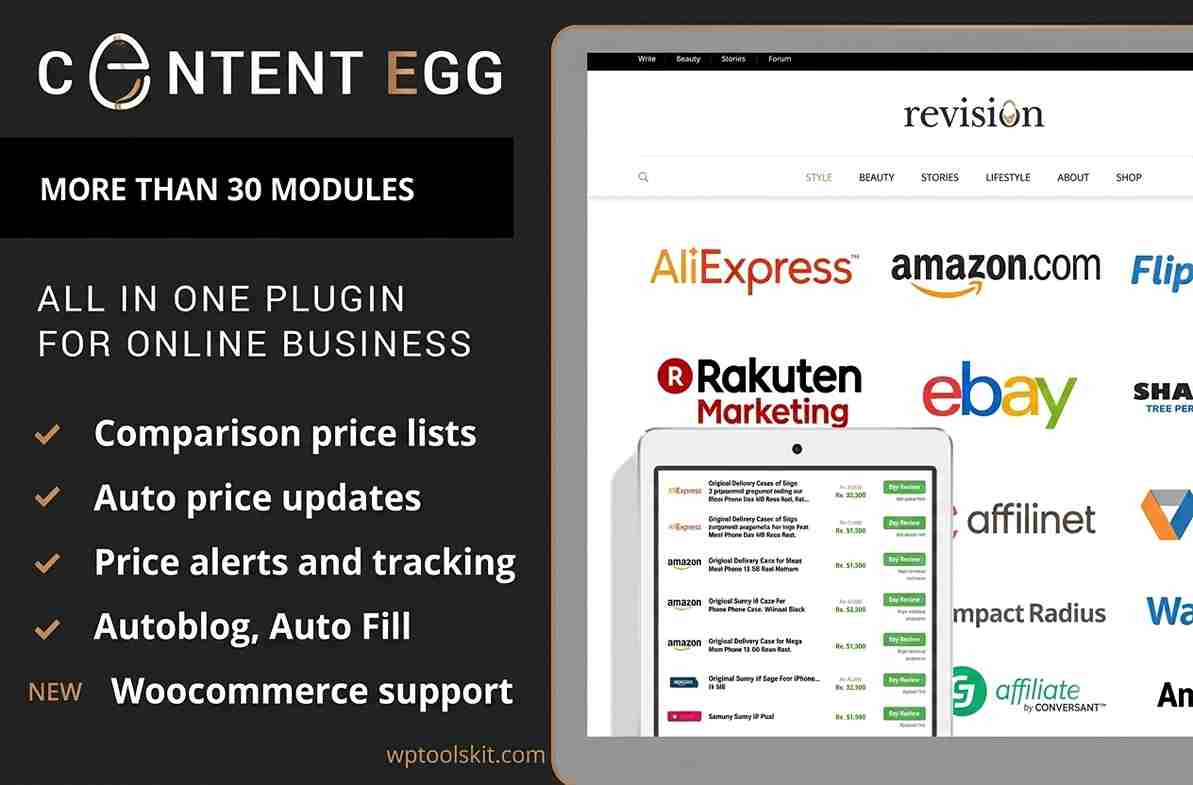
Content Egg Affiliate Marketing Plugin
We can use the Affiliate Marketing Plugin it to import offers, synchronize product data, update prices, view price history, show multiple merchants, and create conversion-oriented product content.
According to the official description of the plugin on the WordPress.org page, the features of Content Affiliate Marketing Plugin include product imports, price comparison, WooCommerce synchronization, scheduled imports, affiliate-link management, AI-based content creation, and more than 25 Gutenberg blocks specifically for product-based content.
Content Egg ffiliate Marketing Plugin: What Is It?
Content Egg Affiliate Marketing Plugin is an affiliate marketing and product data management plugin for WordPress and WooCommerce. The plugin enables us to connect our WordPress site to affiliate networks and merchants and import product data from there.
This plugin is oriented toward the following Affiliate Marketing Plugin site types:
- Product review sites
• Niche affiliate blogs
• Price comparison sites
• Deals and coupons sites
• Automated product websites
• WooCommerce catalogs
• Buying guides
• Product roundups
• Editorial affiliate sites
Features of Content Egg
Content Egg unites several solutions which would normally require additional plugins, custom development, spreadsheets, and manual products management.
- Affiliate Product Importing
Product importing is one of the main advantages of using Affiliate Marketing Plugin.
We can find our required products or offers on different supported sources and put all required information into our WordPress site. Rather than entering manually all the product titles, prices, merchant links, etc., the plugin can fetch all structured data from supported networks.
As stated in the current plugin description, one may benefit from one-click feed import, scheduled automatic imports, bulk keyword imports, and support for CSV, XML, and JSON feeds.
It means that Content Egg can be used by sites that require publishing or maintaining a big product inventory.
- Multiple Affiliate Networks
Content Egg is not restricted to just one affiliate network.
The Pro version provides modules for a variety of affiliate platforms and merchants. Currently listed integrations include Amazon, AliExpress, eBay, Walmart, AWIN, CJ Products, Impact Radius, Rakuten, Shopee, ClickBank, Envato, Flipkart, Best Buy, and many more.
This multiple network capability allows comparing offers from various sources instead of creating a whole site around one merchant.
- WooCommerce Integration
Content Egg also integrates with WooCommerce.
This makes Content Egg helpful in case we want to import product information into our WooCommerce-based site rather than displaying affiliate products only within our blog posts.
Content Egg supports WooCommerce integration and product feed processes including CSV-based products importing.
In this way, a site may use both editorial affiliate content and WooCommerce catalog at once.
- Gutenberg Blocks
Modern-day WordPress sites are using Gutenberg increasingly often, and Content Egg offers specialized blocks tailored for product-based content creation.
The currently available plugin description mentions more than 25 Egg Blocks related to article structure, editorial information, product display, conversion elements, and navigation.
Some examples are:
- Product Cards
• Quick Picks
• Comparison Tables
• Verdict Section
• Rating Sections
• Specifications
• Pros & Cons - FAQS
• Methodology
• Important Takeaways
• Callouts
• Pricing
• Testimonials
• Trust Badges
• Where-to-Buy section
• Related Posts
It will be possible to create structured buying guides without having to create all these elements manually.
Content Egg Templates
Content Egg offers pre-designed output templates as well as enables customized templates.
To customize templates further, we can change them manually by using PHP, HTML, and CSS. Additionally, plugin documentation describes how AI templates can be created.
Customized templates are helpful in case when we need to display the products in a way they fit the current web design.
For instance, the affiliate website can have:
- Branded colors
• Rounded product boxes
• Different buttons’ designs
• Bespoke fonts
• Special spacing
• Bespoke comparison
• Mobile version
Therefore, developers can go beyond the basic presentation in case when the website needs to have more specific design.
Content Egg Feed Modules
Feed modules help us to operate with structured product feeds.
According to plugin documentation, Content Egg allows working with CSV, XML, and JSON feeds. It is also mentioned that the free version of Content Egg can create up to three different feed modules, and the Pro version – up to 50.
This is especially helpful in case when the affiliate network offers a wide list of products via structured feed.
We can use feed filtering and importing features to not include all the products from affiliate network. Instead, we can use only the ones that are suitable for our website’s niche.
Advantages of Using Content Egg
Time Saver for Product Management
Manual product management will become increasingly complicated the more an affiliate site grows.
With Content Egg, we will be able to automate numerous tasks such as importing and updating products.
Multiple Monetization Options Available
With Content Egg, we can create:
- Affiliate websites
• Price comparison websites
• Deals websites
• Coupon websites
• Product review websites
• WooCommerce catalogs
• Guide to shopping websites
Automated Prices Update
Automation of data updates can help cut back on maintenance for large product websites.
Multiple Options for Product Presentation
Products’ information can be displayed in various forms including block, template, shortcode, price comparison, etc.
Good for Large Catalogues
Import of feeds and scheduling will give us the ability to make this plugin useful for our websites with large catalogues of products.
Possible Limitations
Configuring Might Be Time-consuming
Website with multiple affiliate networks will require configuring API keys, feed imports, modules, filters, and displays.
Knowledge of Affiliate Networks Required
Using the plugin does not mean that we can neglect requirements of each affiliate network.
We still need to know about:
- Approval of affiliates
• API limitations
• Link requirements
• Product-data requirements
• Disclosure requirements
• Merchants policies
Content Egg and SEO
Content Egg will help with creating an SEO-friendly affiliate workflow as it allows us to structure product content, comparisons, buying guides, and product information.
New Egg Blocks in Content Egg are tailored towards editorial and commerce content, and some of them allow us to add structured data like FAQ Page markup.
Nevertheless, it doesn’t make the article created via the Content Egg competitive.
A good Content Egg article should still include:
- Search intent-driven headlines
• Product analysis
• Comparisons
• Specifications
• Pros and cons
• Buying advice
• Logical internal links
• Fast layout loading
• Mobile-friendly product displaying
• Proper affiliate disclosures
• Up-to-date product information
Content Egg should be seen as the product-data and monetization layer of the website rather than a complete SEO strategy.
Best Practices for Content Egg Affiliate Websites
Focus on Search Intent
Each page of the site should revolve around a certain need of users.
For instance:
- Best laptops for less than $1,000
• Best WordPress hosting for beginners
• Comparison of Product A and Product B
• Product A Review
• Best products for photographers
The product data should follow the search intent, not vice versa.
Additional Analysis Needed
Information about imported products must not be the whole article.
We need to tell our users what the use case is for each product, which people should purchase the product, which shouldn’t, and how the product compares to other products.
Stay Up-to-date with Pricing Information
Old price data can cause harm to the trust of the user.
Where possible, automatic synchronization should be set up for pricing.
Be Cautious with Comparison Tables
Comparison tables should assist users in decision making, but not duplicate information that is obvious elsewhere.
Optimize Product Images
Images of products need to be optimized so that affiliate product sections don’t unnecessarily bloat page load time.
Disclose Affiliate Relationships
Relationships with affiliates should be disclosed clearly and according to rules of affiliate networks and laws.
Content Egg vs. Manual Affiliate Management
In the absence of a product management plugin, affiliate publishers will have to:
- Figure out products.
2. Copy product data.
3. Add affiliate links.
4. Make product boxes.
5. Add prices.
6. Change prices.
7. Replace unavailable products.
8. Create comparison tables.
9. Monitor product updates.
10. Repeat the steps on various articles.
Content Egg makes these processes easier by providing a one-stop solution within WordPress environment.
It doesn’t make all of these processes automated, but it helps reduce manual repetition and provides a systematic approach to product content management.
Final Verdict
Content Egg is an all-encompassing WordPress solution that combines affiliate marketing, importation of products, price comparison, WooCommerce operations, and automation of products for publishers.
The greatest advantage of Content Egg is its ability to link up product information with WordPress posting. Rather than manually updating every single offer, we have the ability to create an efficient process where the product information is managed through WordPress.